
MSC / MPC
Revised Rating Anchors and Scoring Procedures for Measure of Skill in Conversation (MSC) and Measure of Participation in Conversation (MPC) Between Adults with Aphasia and their Conversation Partners
Overview
The Measure of Skill in Supported Conversation (MSC) and Measure of Participation in Conversation (MPC) are two complementary measures designed to capture elements of conversation between adults with aphasia and their speaking conversation partners.
The MSC provides an index of the conversation partner’s skill in providing conversational support. The MPC provides an index of the level of participation in conversation by the person with aphasia.
The rating anchors for both measures have been revised to be more generically applicable (Kagan, Simmons-Mackie, & Shumway, 2018).
Please click here to access the measures.
Note: Anchors should change according to situation.
References:
For background to the original development of the MSC/MPC, including preliminary psychometric evaluation, please refer to the following article:
Kagan, A., Winckel, J., Black, S., Duchan, J., Simmons-Mackie, N., & Square, P. (2004). A set of observational measures for rating support and participation in conversation between adults with aphasia and their conversation partners. Topics in Stroke Rehabilitation, 11(1), 67-83. https://doi.org/10.1310/CL3V-A94A-DE5C-CVBE
The full reference for the revised version is as follows:
Kagan, A., Simmons-Mackie, N., & Shumway, E. (2018). Revised rating anchors and scoring procedures for measure of skill and measure of participation in conversation between adults with aphasia and their conversation partners. Aphasia Institute. https://www.aphasia.ca/VF_MSCMPC
Aphasia Severity Rating (ASR)
The ASR is a single observational rating that was designed to provide an index of the severity of the aphasia language impairment.
Please click here to access the measure.
Reference:
Simmons-Mackie, N., Kagan, A., & Shumway, E. (2018). Aphasia Severity Rating. Aphasia Institute. https://www.aphasia.ca/health-care-providers/resources-and-tools/rating-scales/#ASR

Measure of Supported Conversation & Behavior Change (MSCBC)
The Measure of Supported Conversation & Behavior Change (MSCBC) rating scale is an adaptation of the Measure of Skill in Supported Conversation (MSC) (Kagan et al., 2018). The MSCBC is designed to assess aphasia therapy sessions by rating a speech-language pathologist’s (SLP) skill in providing communication support/managing the therapy interaction and also using behaviors known to promote behavior change. A small pilot trial found the tool to be reliable, but further psychometric testing is needed to confirm that the MSCBC reliably captures SLP skill in interaction and support of behavior change.
Please click here to access the measure.
Reference:
Simmons-Mackie, N. & Kagan, A. (2022). Measure of Supported Conversation & Behavior Change (MSCBC). Aphasia Institute. https://www.aphasia.ca/VF_MSCBC
The “Wall Question”
A single-item quality of life measure for aphasia
Overview
The Wall Question is a self-report rating on quality of life (QoL) for people with aphasia. This is a rating designed to gain insight into the perspective of the person with aphasia regarding the degree to which aphasia creates a barrier to participating in life. It is designed for use at a stage where the person with aphasia has some experience in living with aphasia – in other words, beyond the acute care phase of the healthcare continuum.
The speech-language pathologist asks the patient/client to rate their life with aphasia using a pictograph referred to as the “Wall Question”, excerpted from the Assessment for Living with Aphasia (ALA) (Kagan et al., 2011, 2013; Simmons-Mackie et al., 2014). The participant self-rates the impact of aphasia on their life using a 9-point rating scale ranging from 0 to 4 (with 0.5 intervals).
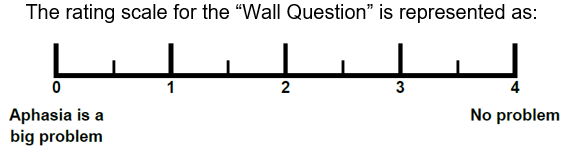
A recent study on the Wall Question that included 103 participants with aphasia provides evidence indicating that the measure is reliable and valid (Kim, Azios et al., 2025). A report on the study is currently in preparation.
Attachments here include:
(1) Clinician script to support administration with a person with aphasia;
(2) Introductory image for the rating scale;
(3) Pictographic support for the Wall Question.
Clinicians should be trained in the evidence-based method Supported Conversation for Adults with Aphasia (SCATM) (Kagan, Black et al., 2001). The free Introduction to SCATM eLearning module as well as in-depth SCATM training for healthcare professionals are available from the Aphasia Institute.
Please click here to access the measure.
References:
Kagan, A., Black, S., Duchan, J. F., Simmons Mackie, N., & Square, P. (2001). Training volunteers as conversation partners using “Supported Conversation for Adults with Aphasia” (SCA): A controlled trial. Journal of Speech, Language, and Hearing Research, 44(3), 624-638. doi:10.1044/1092-4388(2001/051)
Kagan, A., Simmons-Mackie, N., Victor, J. C., Carling-Rowland, A., Hoch, J., Huijbregts, M., Streiner, D., & Mok, A. (2013). Assessment for Living with Aphasia (ALA) (2nd ed.). Aphasia Institute.
Kim, E. S., Azios, J. H., Love, S., Chan, M. T., Strong, K. A., Shumway, E., Simmons-Mackie, N. & Kagan, A. (2025, May 29). Examining Reliability, Concurrent and Face Validity of “The Wall Question” as a Standalone Measure of Quality of Life [Paper presentation]. Clinical Aphasiology Conference, Albuquerque, NM. Designated as an “Audrey Holland Memorial Platform Presentation”. https://clinicalaphasiologyconference.org/wp-content/uploads/2025/07/cac_2025_abstracts.pdf
Simmons-Mackie, N, Kagan, A., Victor, J. C., Carling-Rowland, A., Mok, A., Hoch, J. S., Huijbregts, M., & Streiner, D. L. (2014). The Assessment for Living with Aphasia: Reliability and construct validity. International Journal of Speech-Language Pathology, 16(1), 82-94. doi:10.3109/17549507.2013.831484